
Weather (BCI)
CGI applied to atmospheric systems demonstrates domain transfer validation.
BCI
CGI for Atmospheric Systems: Ensemble Forecast Diagnostics
The Bias-Coherence Index (BCI) applies the Consciousness Gradient Index framework to weather forecasting, demonstrating CGI's domain-independent applicability. Originally developed to measure neural coherence in consciousness states, the same √(φ × ρ) formula—with domain-appropriate operationalizations—successfully identifies when ensemble weather forecasts may be unreliable despite tight model agreement.
This atmospheric validation proves CGI captures fundamental properties of complex system coherence, not just neuroscience-specific patterns.

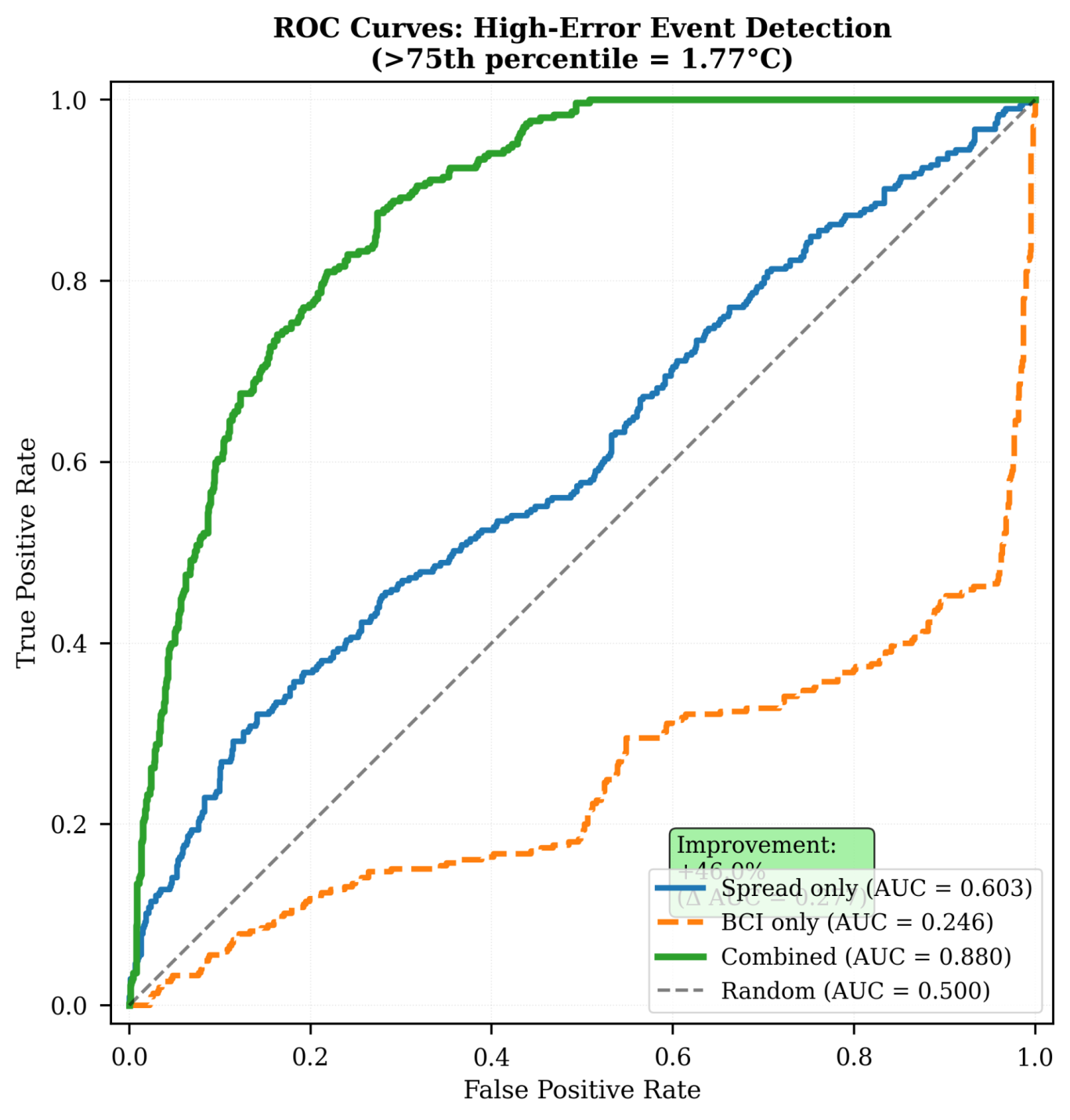
What it measures: CGI applied to atmospheric systems identifies when ensemble forecasts may be unreliable despite tight model agreement. The Bias-Coherence Index (BCI) quantifies inter-model bias consensus independent of ensemble spread—capturing situations where models "agree but are wrong together."
High BCI = coherent bias consensus (elevated error risk)
Low BCI = independent model behaviour (more reliable agreement)
Why this matters: A formula developed for consciousness measurement—with no weather-specific tuning—demonstrates robust predictive skill for ensemble forecast errors. This validates that CGI = √(φ × ρ) captures fundamental properties of complex system coherence across domains.
Operational forecasters need reliable uncertainty diagnostics during high-impact weather events. BCI provides a computationally lightweight complement to ensemble spread (0.001 seconds per forecast), flagging situations where model consensus may be misleading.
Operationalisation (Atmospheric Systems):
φ (bias-adjusted consensus) = Inter-model bias coherence
- Directional agreement: Do models share bias direction?
- Magnitude consistency: How similar are bias magnitudes?
- Weighted 70/30 (direction/magnitude) via optimization
ρ (spread-skill consistency) = Error pattern stability
- Ratio of ensemble spread to forecast error
- Indicates whether spread accurately reflects uncertainty
BCI = √(φ × ρ) - Same geometric mean structure as consciousness measurement
Validation Results:
Dataset: 1,218 forecast-observation pairs
Storms: 14 major UK extratropical cyclones (2021-2024)
Locations: 4 sites across UK/Ireland (440 km N-S, 530 km E-W)
Models: ECMWF + CMC ensembles (TIGGE archive)
Variable: 2-meter temperature at 0-24 hour leads
Key Findings:
✅ Orthogonal information: Partial correlation r = -0.534 (p < 10⁻⁹⁰) controlling for ensemble spread
✅ High-error detection: AUC = 0.880 combining BCI + spread (46% improvement over spread alone)
✅ Geographic consistency: BCI range 0.689-0.748 across all locations
✅ Computational efficiency: 0.001 seconds per forecast time
✅ Parameter optimization: 70/30 directional/magnitude weighting validated via sensitivity analysis
Storms validated: Arwen, Malik, Dudley, Eunice, Franklin, Noa, Babet, Ciarán, Debi, Fergus, Gerrit, Henk, Isha, Jocelyn
Publication Status:
Publication Status:
Manuscript submitted to Weather and Forecasting (American Meteorological Society)
Submission date: December 29, 2025
Manuscript number: WAF-S-25-00335
Preprint & Code:
📊 Data: https://doi.org/10.5281/zenodo.18079447
💻 Code: https://github.com/a1hulahoop-svg/bci-validation
Related work:
🔬 Unified CGT Framework: https://doi.org/10.5281/zenodo.
Applications:
- Operational forecast centers: Real-time ensemble diagnostic
- Multi-model systems: Bias consensus detection
- High-impact weather: Enhanced confidence assessment
- Extratropical cyclones: Validated for UK/North Atlantic storms
Domain Transfer Validation:
BCI represents CGI applied to atmospheric ensemble systems, demonstrating the framework's generalizability beyond neuroscience. The same √(φ × ρ) formula that achieves 100% directional accuracy in consciousness state discrimination also provides 46% improvement in weather forecast error detection—with no domain-specific modifications to the core mathematics.
This cross-domain consistency validates CGI as a universal principle of complex system measurement.
Data source: TIGGE (ECMWF/CMC ensembles) + Open-Meteo observations
Validation period: 2021-2024
Geographic coverage: UK & Ireland